
Indian benchmark indices Sensex and Nifty experienced a significant slump in early trade, driven by a sharp surge in crude oil prices above USD 120 per barrel, weak global market trends, and continued foreign fund outflows.
Indian equities on Dalal Street saw volatility as global market trends and fresh tariff concerns linked to Donald Trump impacted investor sentiment. Track Sensex, Nifty50 movement and key market drivers for April 9, 2026.

Indian equity benchmark indices Sensex and Nifty surged significantly in early trade, mirroring a global market rally and a drop in crude oil prices below USD 100 per barrel, driven by renewed hopes of diplomatic engagement between the US and Iran.

Indian equities on Dalal Street saw volatility as global market trends and fresh tariff concerns linked to Donald Trump impacted investor sentiment. Track Sensex, Nifty50 movement and key market drivers for March 30, 2026.
Indian equity benchmarks, Sensex and Nifty, ended lower after a spectacular rally, with the Sensex tumbling 931 points, as renewed tensions in West Asia, particularly the risk to the ceasefire deal after Iran closed the Strait of Hormuz, dampened investor optimism.

This is the second-worst performance by the pack during this period over the last five years since CY20.

Investor sentiment across Asian markets has shifted sharply in August, reveals the latest Bank of America (BofA) Fund Manager Survey, which found global growth expectations retreating after three months of improvement.

Among Sensex firms, Tata Steel, HCL Tech, UltraTech Cement, Bharat Electronics, Sun Pharma and Tata Consultancy Services were the major gainers. However, Axis Bank, Titan, Maruti and Tata Motors were among the laggards.

IndusInd Bank, Nestle, UltraTech Cement, Mahindra & Mahindra, Power Grid, Asian Paints, Sun Pharma and Tech Mahindra were also among the laggards. Bajaj Finance, Bharti Airtel, ICICI Bank, Adani Ports and HCL Tech were among the gainers.

From the Sensex firms, Infosys declined by 3.54 per cent. Power Grid, Eternal, HCL Tech, Tata Consultancy Services, Bharti Airtel, IndusInd Bank, NTPC and HDFC Bank were the major laggards. Sun Pharma, Adani Ports, Bajaj Finance, State Bank of India and Tech Mahindra were the gainers.

The overall market breadth was negative as 1,989 stocks declined against 882 advancing ones, on the BSE.
Domestic benchmark equity indices may see a positive trading sentiment on Friday thanks to a spectacular rally in world markets after the US President Donald Trump announced to put tariff hikes on hold for 90 days, excluding China from the reprieve. Indian stock markets were closed on Thursday for Shri Mahavir Jayanti. Trump has declared a three-month pause on reciprocal tariffs on non-retaliating countries marking a rather unexpected U-turn after record high levies he imposed led to global stock market meltdown.

Analysts said that there is some amount of decoupling between India and the rest of world backed by strong growth momentum.

Nikkei is one of the largest media houses in Japan.
The rupee fell because of fresh demand for dollar from importers.
India's sad export figure put pressure on the rupee
'India's fundamentals are a lot better (than those of other emerging market economies).' 'India will suffer (witness a fall in its stock market) what I call the second order effect.' 'And the second order will happen when these funds (belonging to macro and hedge fund investors and which have leveraged Japanese yen-carry trades), because they lose money elsewhere as lot of their positions were financed by borrowing Japanese yen, will have to book profits in investment destinations where they are making money, including in markets like India.' 'They (these investors) will have to effectively sell in countries like India and which is the consequence (the crash in equity markets) that Indian markets might see.'

The NSE Nifty ended at 5505, lower by 38 points. Market breadth is negative, 1802 stocks are declining for 1122 advancing stocks.

Benchmark BSE Sensex rose by 319 points on Monday on gains in IT and financial stocks after positive quarterly results amid supportive global cues. The 30-share BSE barometer rose by 319.90 or 0.53 per cent to close at 60,941.67. The index opened higher and gained more than 400 points to scale the 61,000 level. It touched a high of 61,113.27 and a low of 60,761.88 in the day.
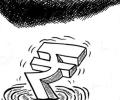
Good foreign capital inflows failed to restrict the rupee's fall against the dollar

The rupee depreciated further by 7 paise to 65.12.

Benchmark Sensex trimmed early gains to close marginally higher while Nifty settled flat in choppy trade on Tuesday as gains in auto shares were offset by selling pressure in banking and energy shares. The 30-share BSE barometer closed marginally up by 37.08 points or 0.06 per cent to 60,978.75 with 15 of its stocks ending in green and the rest in red. The index opened higher and gained over 300 points to a high of 61,266.06 in early trade.


The rupee had gained by 50 paise or 0.75 per cent in two weeks.

Markets pared early gains and ended on a flat note, weighed down by profit-taking in Oil & Gas and Auto shares. The Sensex ended at 17,850 - up three point. Nifty ended flat at 5,415.
About 1,556 shares have advanced, 1,211 shares declined, and 182 shares are unchanged.

Tata Motors, ONGC, HDFC and TCS were the top gainers.
Infosys, TCS, ICICI Bank and Sun Pharma among the top losers of the hour.

The main losers on the Sensex were Tata Steel, Hero Moto, BHEL, ONGC & Maruti Suzuki.
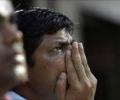
RIL, HDFC twins, M&M, Infosys among the top losers for the day.

BSE Mid-cap index ended at a record closing high of 10499.86 and CNX Mid-cap index ended at a record closing high of 12672.85 levels.

Other than ITC, other laggards include PowerGrid, Infosys, M&M, NTPC, SBI, HDFC, Kotak Bank, HDFC Bank, TCS, Hero MotoCorp, Coal India, ONGC, RIL, Asian Paint, IndusInd Bank, ICICI Bank, Maruti Suzuki, Bajaj Auto, Tata Motors, Bharti Airtel and Axis Bank.
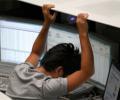
Stocks of companies having operations and exports to Europe were the top losers.

The Nifty and Bank Nifty ended at record closing high of 7,913 and 15,865 respectively.

BSE Smallcap index outperformed the frontline indices to rise 0.6%, while the BSE Midcap was flat

Beijing did not announce expected policy support over the weekend
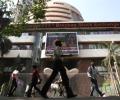
BSE Mid-cap and BSE Small-cap lost 2.5% and 3.1% after oil prices soared

Major global indices - the Nasdaq, Bovespa, Seoul Composite, S&P 500, Dow Jones, S&P BSE Sensex, NYSE, DAX, Nikkei and, CAC 40 - have all gained 37 per cent to 75 per cent since their respective March 2020 low.

The impact of Shinzo Abe's towering personality is such that even in death, Abe remains a polarising figure, asserts Dr Rajaram Panda.

Coal India fell the most by 2.58 per cent among Sensex scrips, dragging the index into the negative zone.
 © 2026 Rediff.com - Advertise with us - Disclaimer - Privacy Policy - Sitemap - Feedback - About us - Terms of use - Grievances